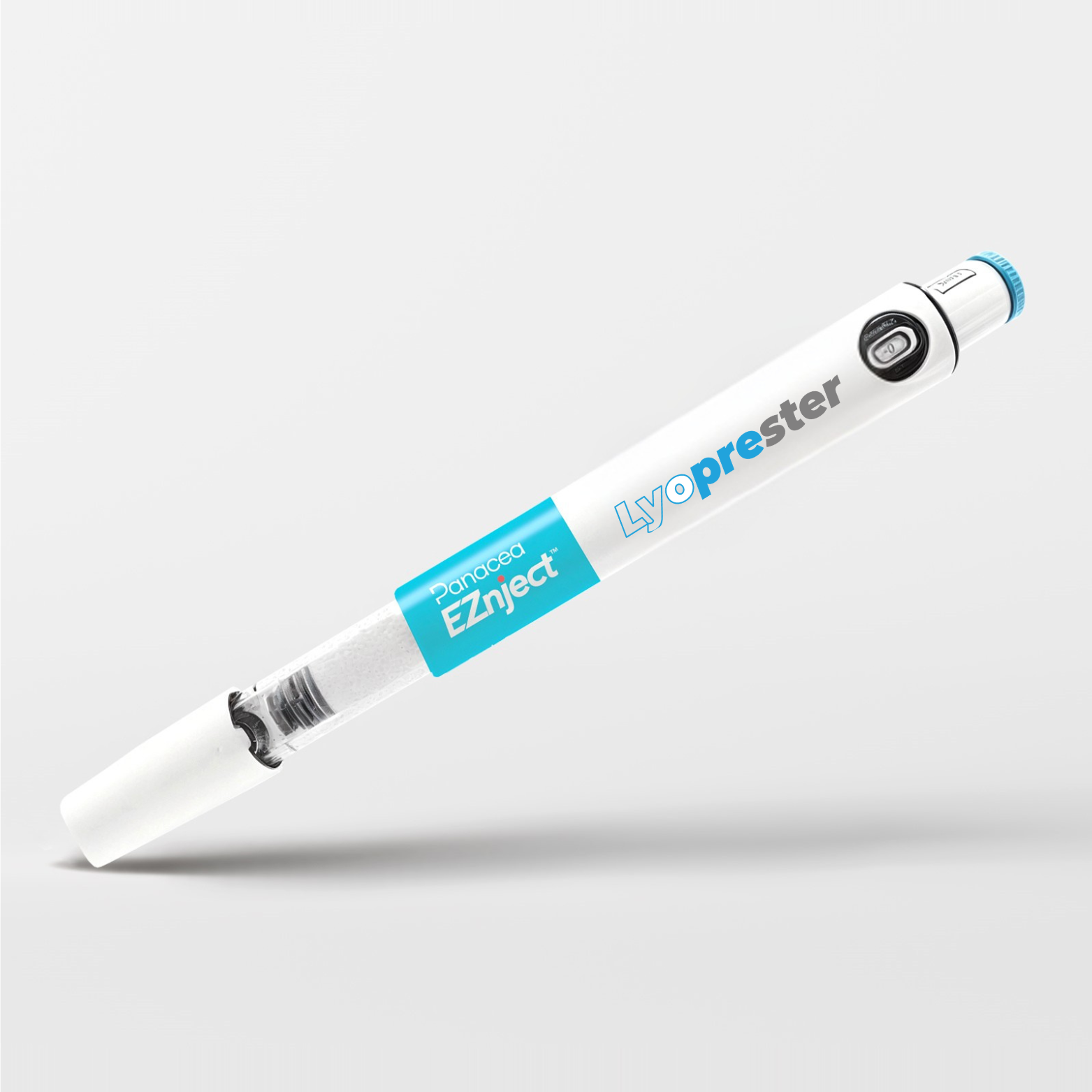
The dual-chamber cartridge: keeping a freeze-dried peptide and its diluent apart until the moment of use

A dual-chamber cartridge is a single two-compartment device that keeps a dry substance and its liquid diluent apart, then mixes them fresh in one action at the point of use. For a fragile peptide, the freeze-dried (lyophilised) cake rides in one chamber and its diluent in the other, separated by a movable bypass seal, so the peptide stays in its most stable dry state until the instant it is needed — no pre-mixed vial, no separate diluent bottle, no manual transfer. This brief explains the two-compartment principle in plain language, why fresh-at-use mixing matters, and how Panacea Bio Chem realises the idea in the Lyoprester® cartridge. It is a beneficial scientific description, not medical advice.
1. What a dual-chamber cartridge is
Start with the everyday problem. Many injectable medicines are shipped dry, as a freeze-dried cake, because a fragile molecule survives far better without water around it. But a dry cake is not a dose — before it can be given it must be reconstituted: the correct diluent, in the correct volume, mixed in without contamination. In the conventional format that means two containers (a powder vial and a diluent vial) and several careful manual steps.
A dual-chamber cartridge collapses those two containers into one. It is a single cylinder divided into two internal compartments: a front chamber holding the dry cake and a rear chamber holding the diluent, held apart by a movable bypass seal. Everything the dose needs travels together, dry and wet kept separate, until a single action at the point of use joins them. The device class is not exotic — it is a quietly established piece of drug-delivery engineering, applied here to the peptide.
PRINCIPAL ELEMENTS
- A single cartridge body with a front (dry) chamber and a rear (diluent) chamber.
- A movable bypass seal holding the two compartments isolated through manufacture, shipping and storage.
- A bypass region in the cartridge wall that, when reached, opens a channel between the chambers.
- A single point-of-use action that drives diluent into the cake, mixing a fresh solution in place.
2. The fresh-mix action — one motion, powder into diluent
The mechanism that gives the format its name is the bypass. The rear (diluent) chamber sits behind the front (dry) chamber, both plugged by stoppers. Advancing the plunger pushes the whole liquid column forward until the front stopper reaches the bypass region — a slightly widened section of the cartridge wall. There the seal no longer blocks the path, and the diluent flows around the stopper into the dry chamber, flooding the cake. The cake dissolves in place; a further push then delivers the finished solution. Powder and diluent meet in one closed, self-contained motion, and only at the moment of use.
| Stage | Dry chamber | Diluent chamber |
|---|---|---|
| Storage | Freeze-dried cake, isolated | Diluent, isolated |
| Activation | Front stopper reaches bypass | Diluent flows past the seal |
| Mixing | Cake dissolves in place | Chamber empties into the cake |
| Delivery | Fresh solution expelled | — |
3. Why keeping them apart matters
The value of the second chamber is not only tidiness — it is chemistry and time. A peptide is usually happiest in the dry, glassy freeze-dried state, where the reactions that spoil it in water — aggregation, oxidation, hydrolysis, deamidation4 — slow to a crawl. Give it water too early and the clock starts; the pre-mixed liquid begins ageing on the shelf. By holding the diluent in its own chamber, a dual-chamber cartridge lets the cake stay dry right up to the instant of use, so the solution the recipient receives is made fresh. Three concrete gains follow:
- No premature reconstitution. The peptide meets water only at use, not months earlier — the dry cake carries the long, forgiving shelf life.
- No transfer error. There is no drawing-up of a separate diluent, no injecting it into a powder vial, no measuring by hand — the diluent is pre-metered inside the device.
- A closed path against contamination. Mixing happens inside a sealed cartridge rather than across an open needle transfer between two vials.
| Dimension | Powder vial + separate diluent | Dual-chamber cartridge |
|---|---|---|
| Containers at use | Two vials + syringe | One cartridge |
| Manual steps | Draw, inject, swirl, withdraw | One action |
| Diluent volume | Measured by hand | Pre-metered in-device |
| Mixing path | Open needle transfer | Closed internal bypass |
| Peptide's wet time | Months (once mixed) | Minutes (mixed at use) |
4. An established device class
Two-compartment delivery is a well-worn idea, not a novelty. Dual-chamber syringes and cartridges2 have carried reconstituted growth hormone, emergency glucagon and lyophilised vaccines for decades: powder in front, diluent behind, a bypass channel between, and a single stroke that mixes and delivers. Clinical work has looked closely at how quickly and completely such devices reconstitute a cake compared with hand-mixing from separate vials3. The format exists precisely because separate-vial reconstitution is fiddly and error-prone exactly where careful hands and clean benches are scarce. What Panacea brings is that same principle, rebuilt around a fragile peptide cake and its matched chemistry.
5. Panacea Bio Chem's realisation — the Lyoprester cartridge
Lyoprester — a pre-filled, self-reconstituting dual-chamber cartridge
Panacea Bio Chem researches the dual-chamber cartridge for fragile peptides, and Lyoprester® is the name of that realisation: a pre-filled two-chamber cartridge in which a freeze-dried peptide cake rides above its matched P-EARLs™ diluent, held apart until a single action fresh-mixes the dose at the point of use. It is the two-compartment principle described above, carried into Panacea's peptide platform so that a peptide which must ship dry can still be dosed fresh, in one motion. Lyoprester is described here as an ongoing programme; the exact chamber geometry, bypass sequencing, fill volumes and materials are a proprietary Panacea matter held by Bogdan Dicoias and are not published on this page.
Because a cartridge is only as good as the cake inside it, the device and the freeze-dry are designed together. The cake is built clean and fast-dissolving with the Cryolapse™ low-temperature lyophilization →, dried under the watch of the S3Pulse™ biointegrity engine →, and a Peptourbillon™ peptide blend → is the payload the chambers are built around. The same blend can be carried as a single liquid in the Liquiprester™ multi-peptide liquid →, or dosed as a lyophilised injectable through Lyoject™ →.
Go to the realised product
See the Lyoprester dual-chamber cartridge ↗Lyoprester is presented here as science and device format, not a purchase claim, dose or instruction. Nothing here is medical advice.
Delivering the finished dose is the job of the EZnject™/SensiPen metering pen →, and the gentle drying that keeps a cake from collapsing is helped by TgShift™ →. The outline of the work is public; the specifics stay behind the door — the mystery is the point, and the recipe is Panacea's.
6. Where the dual-chamber cartridge reaches furthest
The format earns the most where separate-vial reconstitution hurts the most — where a dry, stable peptide must be dosed away from a clean bench:
- Point-of-care peptide dosing — a freeze-dried peptide fresh-mixed at the bedside in one motion, with no pharmacy reconstitution step.
- Field & remote settings — where a separate diluent vial and a clean transfer cannot be assumed.
- Self-administration — a self-contained device lowers the skill needed to prepare a two-vial product correctly.
- Peptides unstable in solution — molecules that must ship and store dry, yet still need to arrive as a fresh liquid dose on demand.
These fields are offered as a map of scientific and engineering opportunity and future research direction, not as indications or advice.
Frequently asked
What is a dual-chamber cartridge?
A single two-compartment device: a
dry cake in one chamber and its diluent in the other, held apart by a bypass seal. A
single action drives the diluent into the cake, mixing a fresh solution with no
separate vial and no manual transfer.
Why keep the peptide and diluent apart until use?
Peptides are most
stable in the dry freeze-dried state; in water they slowly degrade. Separate chambers
keep the cake dry through storage and mix it only at use, for a long shelf life and a
fresh-at-use solution.
How does the fresh-mix action work?
Advancing the plunger brings the
front stopper to a bypass region; the diluent then flows past the seal into the dry
cake, dissolves it, and a further push delivers the finished solution — one closed
motion.
How does Panacea Bio Chem realise it?
As Lyoprester® — a
pre-filled dual-chamber cartridge carrying a freeze-dried peptide cake above matched
P-EARLs diluent, built with the Cryolapse method and S3Pulse algorithm and delivered
by the EZnject pen. The exact internal geometry is proprietary to Bogdan Dicoias.
Nothing here is medical advice.
Trending in the field
Recent developments in the field — refreshed 2026-09-07 by Panacea Bio Chem.
- A modeling framework for spring-driven autoinjectors with dual-chamber cartridges — PubMed, 2026 Feb
- Recommended Best Practices for Lyophilization Validation 2021 Part II: Process Qualification and Continued Process Verification — PubMed, 2021 Nov 8
- Dual chamber cartridges in a continuous pharmaceutical freeze-drying concept: Determination of the optimal dynamic infrared heater temperature during primary drying — PubMed, 2019 Oct 30
- Efficacy and safety of an albiglutide liquid formulation compared with the lyophilized formulation: A 26-week randomized, double-blind, repeat-dose study in patients with type 2 diabetes mellitus — PubMed, 2019 Jun
References & further reading
- Reconstitution of medication — preparing a solution from a lyophilised drug and its diluent. Wikipedia.
- Dual-chamber syringes & cartridges — powder and diluent in one barrel with a bypass. Wikipedia (syringe) · Wikipedia (autoinjector).
- Reconstitution time and completeness in dual-chamber devices vs separate vials. PubMed (search).
- Freeze-drying (lyophilization) and the stability of dried biologics. Wikipedia.